


Metalyse® 25 mg (TENECTEPLASE) is available for the thrombolytic treatment of acute ischaemic stroke (AIS) within 4.5 hours from last known well and after exclusion of intracranial haemorrhage1
Because Every
Minute Matters

Time is Brain
Patients with acute ischaemic stroke, regardless of age or stroke severity, in whom treatment can be started within 4.5 hours of known onset, should be considered for thrombolysis with Actilyse®(alteplase) or Metalyse 25 mg.2
Thrombolysis in AIS should be evaluated on an individual benefit-risk basis.1,3 The treatment effect of thrombolysis is time-dependent; therefore, earlier treatment may increase the probability of a favourable outcome of thrombolysis.1,3
Explore below to see how Metalyse 25 mg could help save time and contribute to improving hospital efficiency vs Actilyse.4,5
Workflow benefits
Treating your patients with Metalyse 25 mg may help to streamline workflows due to easier and faster administration with a shorter door-to-needle (DTN) time vs Actilyse.1,3–5
Lower treatment cost per patient with tenecteplase vs Actilyse6
The average UK stroke patient (weighing 79 kg) would require only one vial of tenecteplase compared with up to three vials of Actilyse. This equates to approximate savings of £260.00 per patient.* This assumes the cheapest combination of vials is used to make the required dose of Actilyse, even if this requires more product being wasted. However, not all hospitals have access to all vial sizes, which may increase the cost of Actilyse in those hospitals.6
NICE recommends using the least expensive option of the available treatments (including tenecteplase and Actilyse).7 So consider tenecteplase as an option for thrombolysis in patients with AIS.

* A patient with a mean weight of 79 kg will need 20 mg of Metalyse. The maximum dose of Metalyse is 25 mg. This can all be taken from one vial of Metalyse 25 mg, costing £602.70. For Actilyse, a patient with a mean weight of 79 kg will need 71.1 mg of Actilyse. This will require three vials of Actilyse: one 10 mg vial (£172.80), one 20 mg vial (£259.20), and one 50 mg vial (£432.00) at a total of £864.00.6
Simple preparation and administration with Metalyse 25 mg1,4
Metalyse 25 mg is simpler to administer vs Actilyse.1,3,4 Metalyse 25 mg is administered as a single IV bolus over approximately 5–10 seconds, compared with an IV bolus followed by a 60-minute infusion with Actilyse.1,3,4
Learn more about how to reconstitute and administer Metalyse 25 mg.

Metalyse 25 mg does not require an IV infusion pump for administration4
Metalyse 25 mg requires only one needle, one syringe, and sterile water for administration.†1 This saves on cannulas, extension lines, and other infusion-related consumables that are needed for an Actilyse infusion.3,4
† Syringe, needle and sterile water for injection are not included in the pack. Please source them from your hospital.

Optimised use of nurse time due to faster administration with Metalyse 25 mg vs Actilyse1,3
Treatment with Metalyse 25 mg could save 60 minutes of time or more by removing the preparation and infusion steps associated with the administration of Actilyse.1,3
During a 12-month period, Metalyse 25 mg could save up to 461 days and 19 hours based on 11,083 patients thrombolysed (Apr 2023 – Mar 2024).8

Simple inter-hospital patient transfer with Metalyse 25 mg4
Quicker administration for Metalyse 25 mg vs Actilyse allows a patient to be ready quickly for transfer to a thrombectomy centre.4
Metalyse 25 mg does not require an IV pump or any specialised equipment for administration which removes one potential barrier to rapid inter-hospital transfer for those stroke patients who require it.4

Improved DTN and NTG times in a real-world setting with tenecteplase vs Actilyse5
In a real-world setting of switching from Actilyse to tenecteplase for the treatment of AIS, tenecteplase was associated with a faster DTN time than Actilyse (median DTN [IQR]: 52 [47–83] minutes vs 61 [45–84] minutes, respectively; p<0.0001).‡5
Tenecteplase was also associated with a reduction of median needle-to-groin (NTG) time by 67 minutes when compared with Actilyse for patients who required subsequent thrombectomy (median NTG [IQR]: 118 [74.5–218.5] vs 185 [118–255]; p=0.02).‡5

‡ An analysis of real-world data for 1,408 patients from a compulsory national stroke reperfusion register in the Central Region of New Zealand. Data were extracted for all adult patients treated with tenecteplase 0.25mg/kg or alteplase 0.9 mg/kg between 1 January 2018 and 31 December 2022.5
Webinar series from our expert speakers
Please see the following webinar recordings, developed and funded by Boehringer Ingelheim.
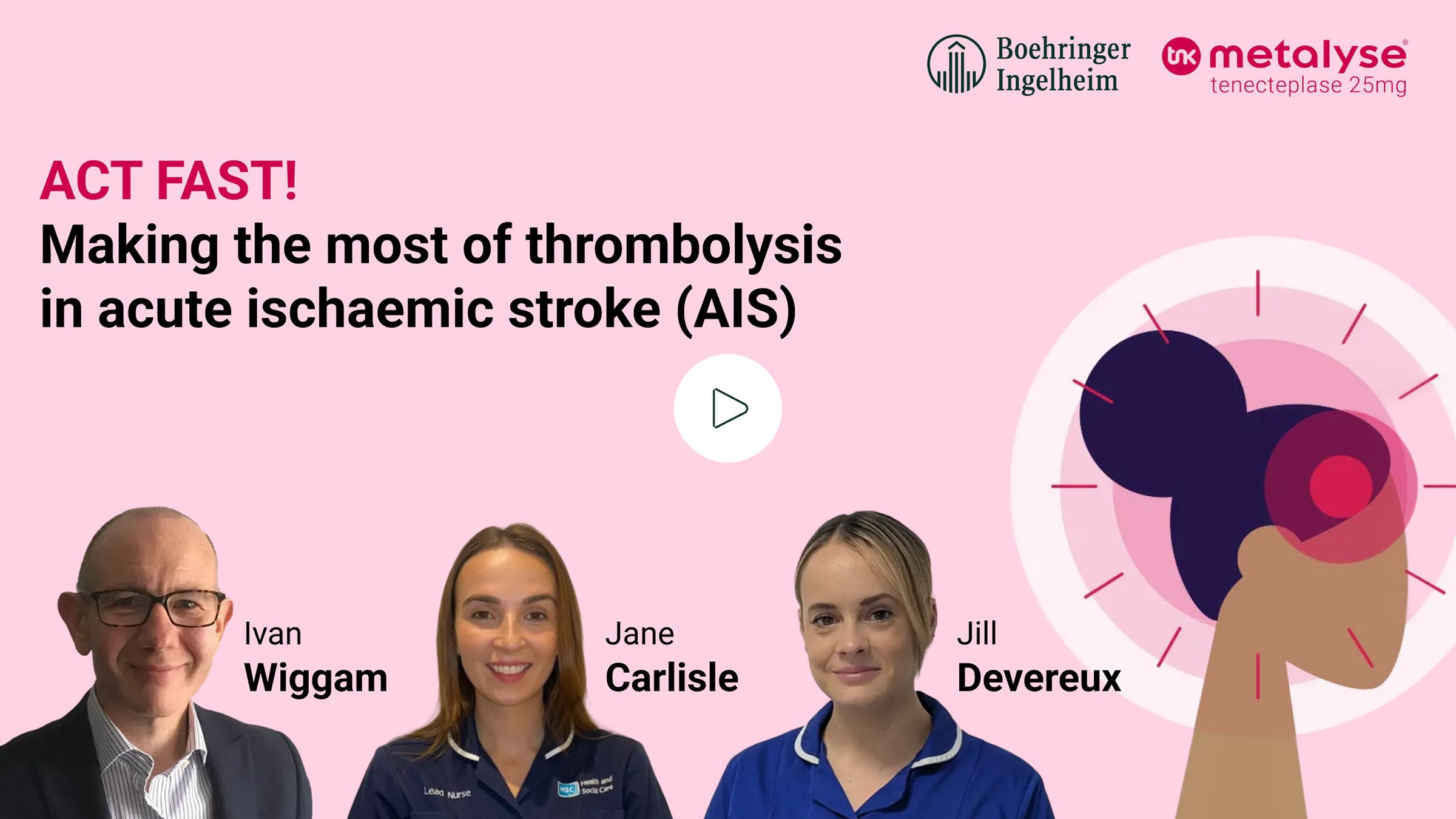
ACT FAST! Making the most of thrombolysis in acute ischaemic stroke (AIS) patients
Our expert speakers below will cover: Real-world insights discussing two case studies for eligible AIS patients treated with Metalyse 25 mg and what can change in clinical practice after transitioning from Actilyse to Metalyse 25 mg in AIS patients.
Dr Ivan Wiggam: Consultant Physician in Stroke Medicine, Royal Victoria Hospital, Belfast
Jane Carlisle: Lead Nurse for Stroke Services, Belfast Health and Social Care Trust
Jill Devereux: Stroke Nurse Practitioner, Royal Victoria Infirmary, Newcastle Upon Tyne
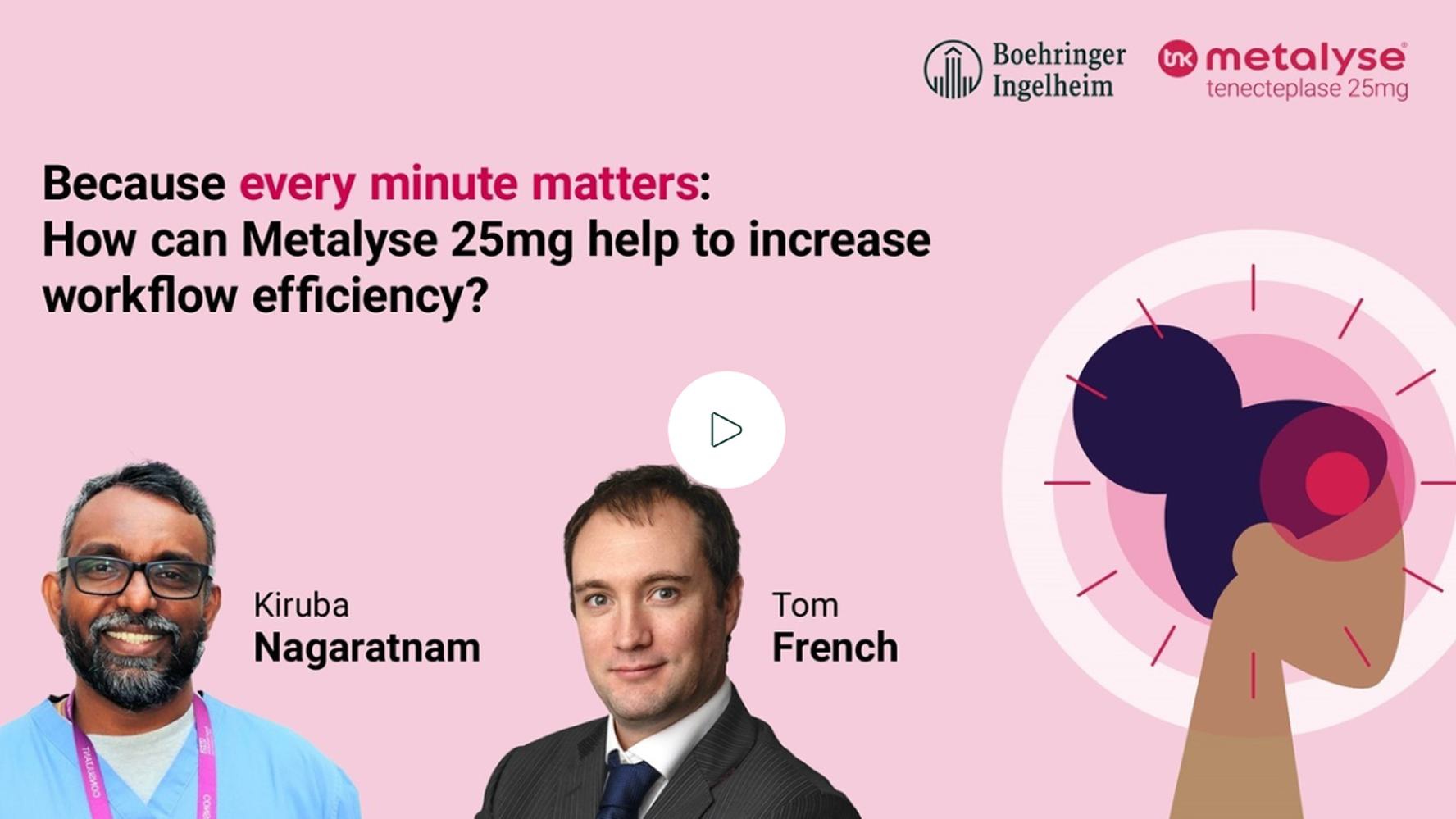
How can Metalyse 25 mg increase workflow efficiency in the thrombolytic treatment of acute ischaemic stroke?
Dr Kiruba Nagaratnam and Dr Tom French discuss how switching their patients from Actilyse to Metalyse 25 mg helped to increase workflow efficiency in the thrombolytic treatment of AIS.

Abbreviations
AIS: acute ischaemic stroke, DTN: door-to-needle, IQR: interquartile range, IV: intravenous, NTG: needle-to-groin.
References
- Metalyse 25 mg (tenecteplase) Summary of Product Characteristics.
- National Clinical Guideline for Stroke for the UK and Ireland. London: Intercollegiate Stroke Working Party; 2023 May 4. Available at: www.strokeguideline.org (accessed April 2026).
- Actilyse (alteplase) Summary of Product Characteristics.
- Zitek T, et al. West J Emerg Med. 2020;21:199–202.
- Ranta, A et al. Eur Stroke J. 2023;8:942–946.
- Boehringer Ingelheim. Data on File. MET 24-01.
- National Institute for Health and Care Excellence (NICE). Tenecteplase for treating acute ischaemic stroke. July 2024. Available at: https://www.nice.org.uk/guidance/ta990/resources/tenecteplase-for-treating-acute-ischaemic-stroke-pdf-82615964148421 (accessed April 2026).
- Sentinel Stroke National Audit Programme (SSNAP). Annual results portfolio, Apr 2023 – Mar 2024. Available at: https://www.strokeaudit.org/Results2/Clinical-audit/National-Results.aspx (accessed April 2026).
- Menon BK, et al. Lancet. 2022;400:161–169.
- Campbell BCV, et al. N Engl J Med. 2018;378:1573–1582.
- Muir K, et al. Lancet Neurol. 2024;23:1087–1096.
PC-GB-110824 V5 April 2026