

How would you treat a severe asthma patient?
SPIRIVA® Respimat® (tiotropium) is indicated as add-on maintenance bronchodilator treatment in patients aged 6 years and older with severe asthma who experienced one or more severe asthma exacerbations in the preceding year. In adult patients with severe asthma, tiotropium should be used in addition to inhaled corticosteroids (≥ 800μg budesonide/day or equivalent) and at least one controller.1
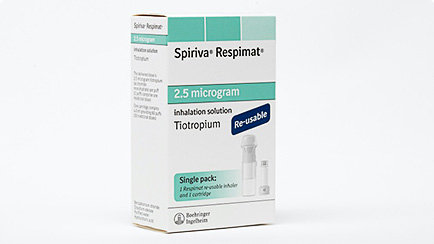
Why SPIRIVA Respimat (tiotropium)?
Two replicate randomised controlled trials compared SPIRIVA Respimat with placebo Respimat over 48 weeks in 912 adult patients with severe asthma who were symptomatic on ICS (≥800 μg budesonide/day or equivalent) plus LABA, had a post-bronchodilator FEV1 of ≤80% of the predicted value and a history of ≥1 severe exacerbation in the previous year. The co-primary endpoints were lung function measured as peak FEV1(0-3h) and trough FEV1 response at week 24, and time to first severe exacerbation (pooled data) over 48 weeks.2
In patients with severe asthma, SPIRIVA Respimat has (against placebo Respimat) demonstrated:
| Significantly improved lung functionUp to 154mL improvement in peak FEV1 (0-3h) vs placebo Respimat (95% CI 91-217; p<0.001).2,3* Up to 111mL improvement in trough FEV1 vs placebo Respimat (95% CI 53-169; p<0.001).2,3* The improvement in lung function was maintained for 24 hours.1 *At 24 weeks, mean difference in improvement in peak FEV1 between Spiriva Respimat and placebo Respimat was 86ml in Trial 1 (p=0.01) and 154ml in Trial 2 (p<0.001); mean difference in improvement in trough FEV1 was 88ml (p=0.01) and 111ml (p<0.01), respectively.2 |

| Significantly reduced severe exacerbation risk†Increased time to first severe asthma exacerbation† requiring corticosteroids vs placebo Respimat by 56 days. (282 days vs. 226 days).2 Reduced severe asthma exacerbation risk by 21% compared to placebo Respimat (HR 0.79 [95% CI 0.62–1.00]; p=0.03).2 †Severe asthma exacerbation defined as deterioration of asthma necessitating initiation or at least doubling of systemic glucocorticoids for ≥3 days.2 |

| Significantly reduced asthma worsening‡Increased the median time to first worsening of asthma by 134 days vs placebo Respimat (315 days, vs. 181 days).2 31% reduction in risk of asthma worsening vs placebo Respimat (HR 0.69 [95% CI 0.58–0.82]; p<0.001).2 ‡Asthma worsening defined as either progressive increase in symptoms or ≥30% decline in the best morning PEF from the mean screening morning PEF for 2 or more consecutive days.2 |

| Significantly improved asthma symptom controlPatients were 68% more likely to have improved asthma symptom control vs placebo Respimat (as measured by pooled analysis of ACQ-7 responder rate at week 48 in post hoc analysis; absolute difference 12.9%; OR 1.68 [95% CI 1.28–2.21]; p<0.001).4,5§ §A response was defined as a change in ACQ-7 score from study baseline of ≥0.5. |
PrimoTinA Study Design
Two replicate randomised controlled trials (PrimoTinA-Asthma 1 and PrimoTinA-Asthma 2) compared SPIRIVA Respimat with placebo Respimat over 48 weeks as add-on controller therapy on top of usual care in adult patients with severe asthma who were symptomatic on maintenance treatment of at least ICS (≥800 μg budesonide/day or equivalent) plus LABA, had a post-bronchodilator FEV1 of ≤80% of the predicted value and a history of ≥1 severe exacerbation in the previous year. In both the SPIRIVA Respimat and placebo Respimat groups, ICS and LABA maintenance therapy was continued. Other asthma medications were allowed if the doses remained stable for ≥4 weeks before study entry and for the duration of the trial. The primary endpoints were lung function measured as peak FEV1(0-3h) and trough FEV1 response at week 24, and time to first severe exacerbation (pooled data) over 48 weeks.2
Abbreviations
ACQ-7, seven-question Asthma Control Questionnaire; CI, confidence interval; FEV1, forced expiratory volume in 1 second; HR, hazard ratio; ICS, inhaled corticosteroids; LABA, long-acting β2-agonist; OR, odds ratio; PEF, peak expiratory flow.
References
- SPIRIVA Respimat (tiotropium) 2.5 μg Summary of Product Characteristics.
- Kerstjens HA et al. N Engl J Med 2012;367:1198–207.
- Kerstjens HA et al. N Engl J Med 2012;367:1198–207, supplementary appendix.
- Kerstjens HA et al. Respir Med 2016;117:198–206.
- Murphy K et al. Annals of Allery Asthma and Immunology Abstract P294. 2014;113:Suppl 1.
Summary of the safety profile
Many of the listed undesirable effects can be assigned to the anticholinergic properties of tiotropium bromide.1
In asthma the incidence of dry mouth was 0.83%. No discontinuations due to dry mouth were reported.1
Serious undesirable effects consistent with anticholinergic effects include glaucoma, constipation, intestinal obstruction including ileus paralytic and urinary retention.1
An increase in anticholinergic effects may occur with increasing age.1
Tabulated summary of adverse reactions
The frequencies assigned to the undesirable effects listed below are based on crude incidence rates of adverse drug reactions (i.e. events attributed to tiotropium) observed in the tiotropium group pooled from 12 placebo controlled clinical trials in adult and paediatric patients with asthma (1,930 patients) with treatment periods ranging from four weeks to one year.1
Frequency is defined using the following convention:
Very common (≥1/10); common (≥1/100 to <1/10); uncommon (≥1/1,000 to <1/100); rare (≥1/10,000 to <1/1,000); very rare (<1/10,000), not known (cannot be estimated from the available data).1
| System Organ Class / MedDRA Preferred Term | Frequency |
| Metabolism and nutrition disorders | |
| Dehydration | Not known |
| Nervous system disorders | |
| Dizziness | Uncommon |
| Headache | Uncommon |
| Insomnia | Uncommon |
| Eye disorders | |
| Glaucoma | Not known |
| Intraocular pressure increased | Not known |
| Vision blurred | Not known |
| Cardiac disorders | |
| Atrial fibrillation | Not known |
| Palpitations | Uncommon |
| Supraventricular tachycardia | Not known |
| Tachycardia | Not known |
| Respiratory, thoracic and mediastinal disorders | |
| Cough | Uncommon |
| Pharyngitis | Uncommon |
| Dysphonia | Uncommon |
| Epistaxis | Rare |
| Bronchospasm | Uncommon |
| Laryngitis | Not known |
| Sinusitis | Not known |
| Gastrointestinal disorders | |
| Dry Mouth | Uncommon |
| Constipation | Rare |
| Oropharyngeal candidiasis | Uncommon |
| Dysphagia | Not known |
| Gastroesophageal reflux disease | Not known |
| Dental caries | Not known |
| Gingivitis | Rare |
| Glossitis | Not known |
| Stomatitis | Rare |
| Intestinal obstruction, including ileus paralytic | Not known |
| Nausea | Not known |
| Skin and subcutaneous tissue disorders, immune system disorders | |
| Rash | Uncommon |
| Pruritus | Rare |
| Angioneurotic oedema | Rare |
| Urticaria | Rare |
| Skin infection/skin ulcer | Not known |
| Dry skin | Not known |
| Hypersensitivity (including immediate reactions) | Rare |
| Anaphylactic reaction | Not known |
| Musculoskeletal and connective tissue disorders | |
| Joint swelling | Not known |
| Renal and urinary disorders | |
| Urinary retention | Not known |
| Dysuria | Not known |
| Urinary tract infection | Rare |
Abbreviations
MedDRA, Medical Dictionary for Regulatory Activities.
References
- SPIRIVA Respimat (tiotropium) 2.5 μg Summary of Product Characteristics.
- Kerstjens HA et al. N Engl J Med 2012;367:1198–207.
- Kerstjens HA et al. N Engl J Med 2012;367:1198–207, supplementary appendix.
- Kerstjens HA et al. Respir Med 2016;117:198–206.
- Murphy K et al. Annals of Allery Asthma and Immunology Abstract P294. 2014;113:Suppl 1.
PC-GB-109562 V1 February 2025