

Empagliflozin
The same Boehringer Ingelheim medicine previously supplied as Jardiance® (empagliflozin)

Empagliflozin can offer TRIPLE PROTECTION for eligible patients vs placebo1-3
T2D, CKD, and/or CVD are interrelated and progressive conditions that can lead to multisystem dysfunction4-6

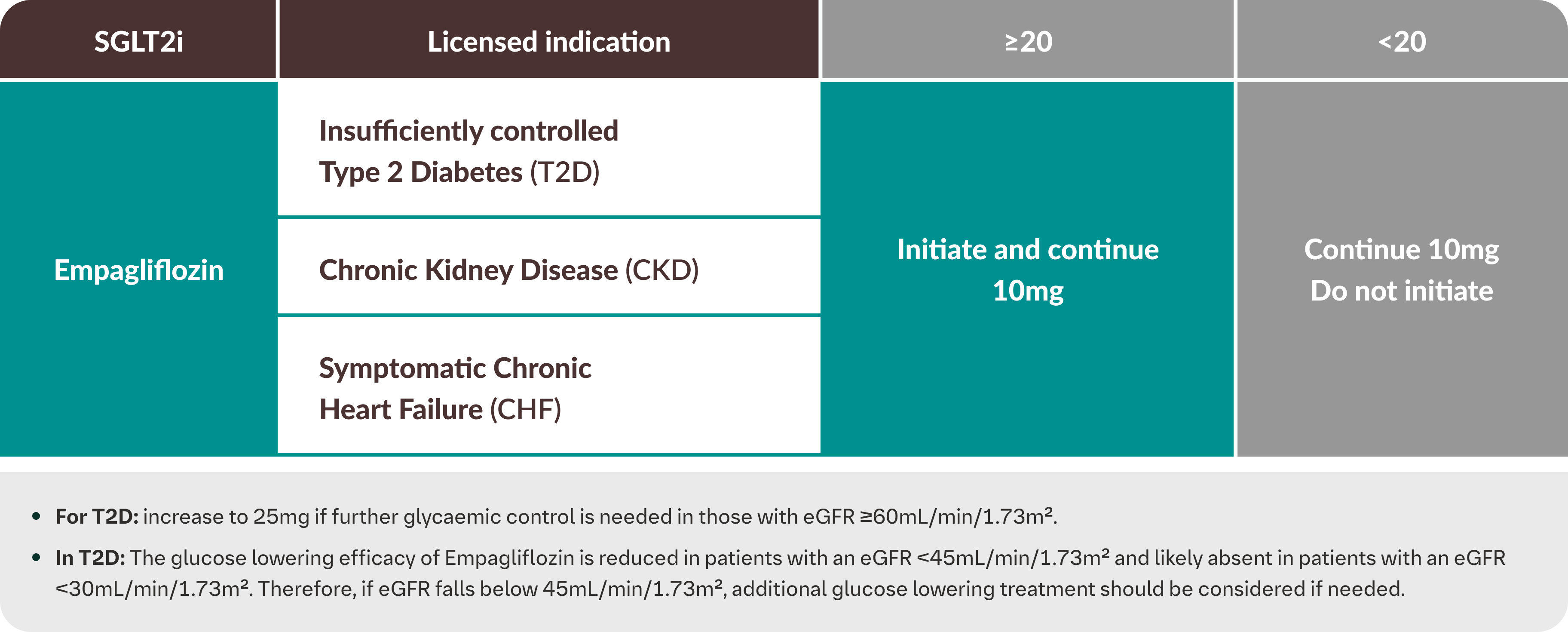
Empagliflozin is simple to initiate at 10 mg dosing across all indications in adults.
Empagliflozin - Dosing and administration


Empagliflozin is not recommended in severe hepatic impairment, should not be used in breastfeeding or type 1 diabetes, and is contraindicated in patients with hypersensitivity to the active ingredient or any of its excipients. Empagliflozin should be avoided in pregnancy. Always refer to the SmPC before prescribing.
*Caution should be exercised in patients for whom an Empagliflozin-induced drop in blood pressure could pose a risk, such as patients with known cardiovascular disease, patients on anti-hypertensive therapy with a history of hypotension or patients aged 75 years and older.
Dose recommendations based on eGFR (mL/min/1.732)
Concise summaries of key clinical evidence
Type 2 diabetes
Chronic kidney disease
Chronic heart failure
CRM Hub
Initiatives and tools that support earlier identification and informed action across cardio-renal-metabolic disease.

“I want to understand the potential number of people living with CKD in my population.”

“I want to slow CKD progression and reduce cardiovascular risk.”

Featured Resource
Celebrating a decade of evidence: EMPA-REG OUTCOME® (2015–2025)
Explore the landmark cardiovascular outcomes trial and its continued relevance to the understanding of cardio-renal-metabolic risk. Access evidence, insights and educational resources that support clinical discussions today.

Abbreviations
CHF: chronic heart failure; CKD: chronic kidney failure; CVD: cardiovascular disease; HF: heart failure; NICE: National Institute for Health and Care Excellence; SGLT2i: sodium-glucose co-transporter-2 inhibitor; T2D: type 2 diabetes mellitus.
- Zinman B, et al. N Engl J Med. 2015;373(22):2117–2128.
- Haring HU, et al. Diabetes Care. 2014;37:1650–1659.
- Herrington WG, et al. N Engl J Med. 2023;388(2):117–127. (EMPA-KIDNEY results and the publication’s Supplementary Appendix.)
- Heidenreich PA, Bozkurt B, Aguilar D, et al. 2022 AHA/ACC/HFSA Guideline for the Management of Heart Failure: a report of the American College of Cardiology/American Heart Association Joint Committee on Clinical Practice Guidelines. J Am Coll Cardiol. 2022;79(17):e263-e421.
- Kadowaki T, Maegawa H, Watada H, Yabe D, Node K, Murohara T, Wada J. Diabetes Obes Metab. 2022;24(12):2283-2296.
- de Boer IH, Khunti K, Sadusky T, et al. Diabetes Care. 2022;45(12):3075-3090.
- National Institute for Health and Care Excellence (NICE) 2023. Empagliflozin for treating chronic heart failure with preserved or mildly reduced ejection fraction. Technology Appraisal Guidance TA929. Available from: https://www.nice.org.uk/guidance/ta929.
- National Institute for Health and Care Excellence (NICE) 2015. Empagliflozin in combination therapy for treating type 2 diabetes. Technology Appraisal Guidance TA336. Available from: https://www.nice.org.uk/guidance/ta336.
- National Institute for Health and Care Excellence (NICE) 2023. Empagliflozin for treating chronic kidney disease. Technology Appraisal Guidance TA942. Available from: https://www.nice.org.uk/guidance/ta942.
- National Institute for Health and Care Excellence (NICE) 2022. Empagliflozin for treating chronic heart failure with reduced ejection fraction TA773. Available at: https://www.nice.org.uk/guidance/ta773.
- Empagliflozin Summary of Product Characteristics (SmPC).
PC-GB-112291 | April 2026
The content on this website is in relation to adult patients.
Empagliflozin is not recommended in severe hepatic impairment, breastfeeding, Type 1 diabetes and is contraindicated in patients with hypersensitivity to the active ingredient or any of its excipients. Empagliflozin should be avoided in pregnancy.
Please consult the SmPC for full details regarding adverse events, monitoring requirements and interactions prior to prescribing Empagliflozin.
- Empagliflozin UK Summary of Product Characteristics (SmPC).
Empagliflozin is indicated for the treatment of adults with insufficiently controlled type 2 diabetes mellitus as an adjunct to diet and exercise
- as monotherapy when metformin is considered inappropriate due to intolerance
- in addition to other medicinal products for the treatment of diabetes1
Empagliflozin is indicated in adults for the treatment of chronic kidney disease.1
Empagliflozin is indicated in adults for the treatment of symptomatic chronic heart failure.1
PC-GB-112290 | April 2026