

ACT EARLYto support your patients with cardiovascular risk
Watch Dr. Janaka Karalliedde discuss the importance of acting early.

Why early intervention matters
On average, a 55-year-old female with cardiovascular disease (MI and stroke) and diabetes dies 17 years earlier than a female of the same age with neither condition.1
By acting early, you can make a meaningful impact—adding years to life and life to years. Learn how Empagliflozin can support you.

Cumulative survival was estimated by applying calculated age-specific HRs for mortality to contemporary US age-specific death rates. Data based on the analysis of Emerging Risk Factors Collaboration (ERFC) results from 689,300 participants compared with UK Biobank, a prospective cohort study of 499,808 participants. Years of life lost is according to age 55 at baseline compared with people with neither diabetes nor CVD.
-
*
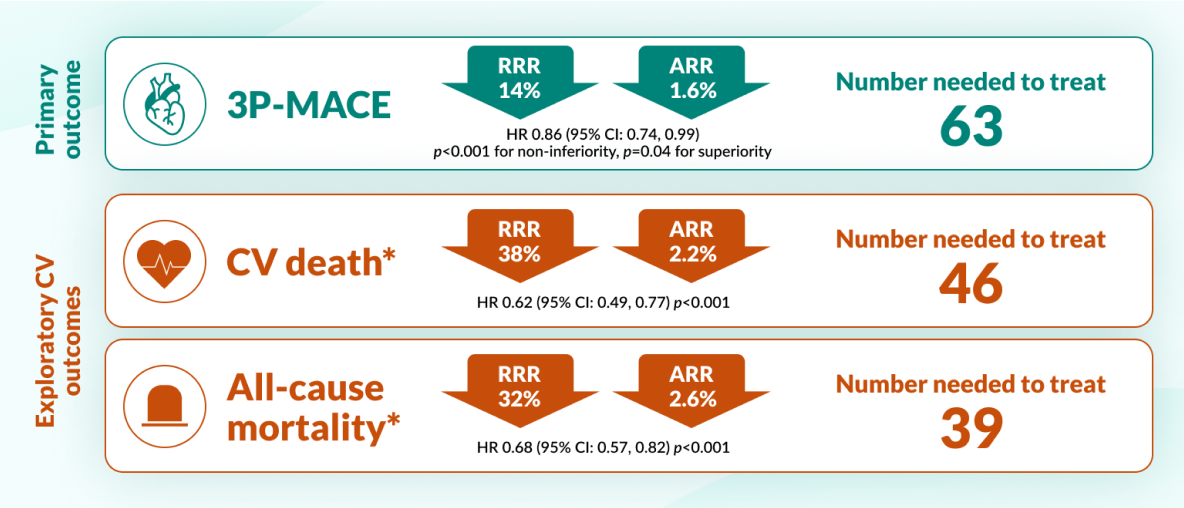
EMPA-REG Outcome® Trial: A randomised, double-blind, placebo-controlled cardiovascular outcomes trial (n=7020). Patients with T2D and CVD were randomised to receive Empagliflozin (10mg or 25mg) (n=4687) or placebo (n= 2333) once daily, on top of standard of care. Patients were adults with insufficiently controlled T2D and CAD, PAD, or a history of MI or stroke. Primary endpoint for Empagliflozin (pooled figures for 10mg and 25mg dose vs placebo): 3-point MACE (time to first occurrence of CV death, non-fatal myocardial infarction or non-fatal stroke), 14% RRR (1.6% ARR) HR 0.86, 95% CI 0.74–0.99, p=0.04 for superiority. Pre-defined exploratory endpoint for Empagliflozin (pooled figures for 10mg and 25mg dose vs placebo): CV death 38% RRR (2.2% ARR) (HR 0.62, 95% CI 0.49–0.77, p<0.001).2
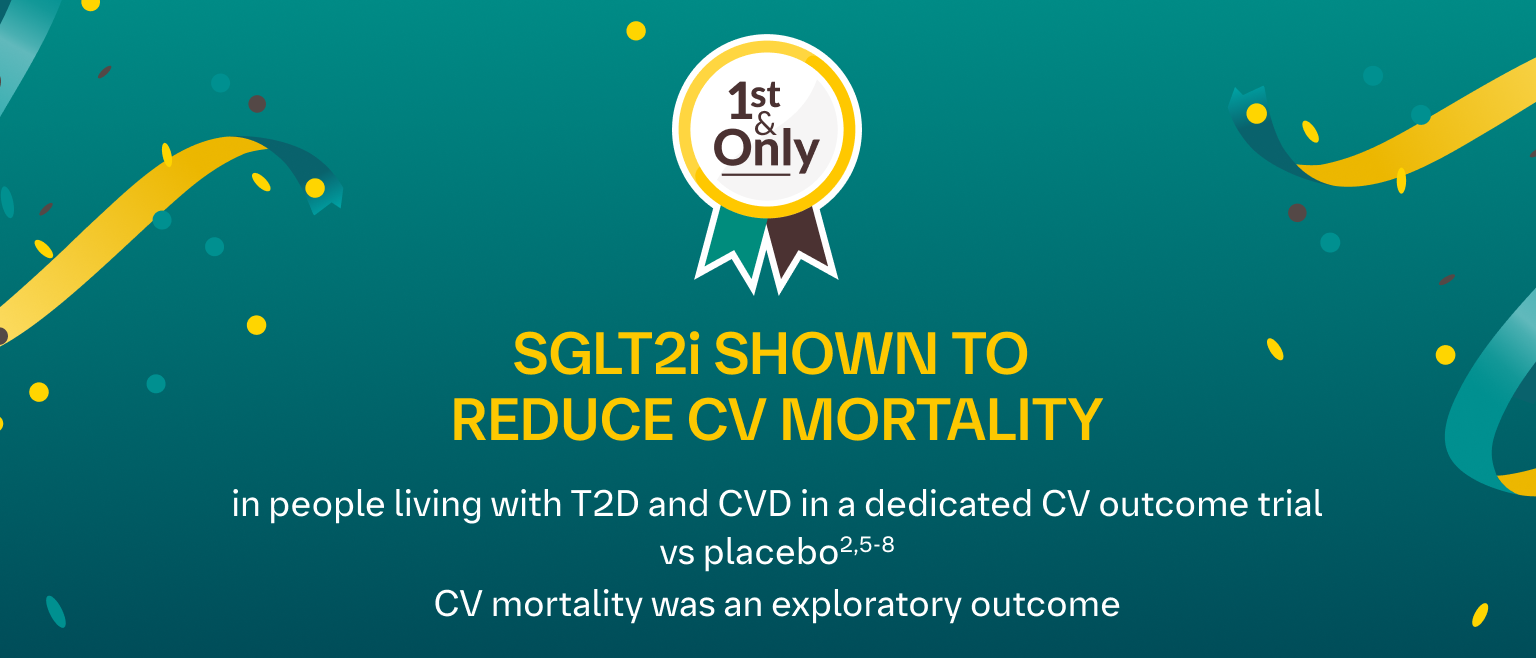
Empagliflozin reduced mortality and risk of CV events vs placebo in adults with T2D and CVD2
CV death and all-cause mortality were predefined exploratory outcomes of the EMPA-REG Outcome® trial*.
Empagliflozin reduced the risk of CV death EARLY vs placebo2
EMPA-REG OUTCOME: pre-defined exploratory outcome and post-hoc analysis
CV death was a pre-defined adjudicated exploratory endpoint. Unless otherwise stated, pooled data for Empagliflozin 10 mg and 25 mg are represented. The efficacy for preventing CV mortality has not been conclusively established in patients using Empagliflozin concomitantly with DPP-4is or in black patients because the representation of these groups in the EMPA-REG OUTCOME trial was limited.2

Empagliflozin can add years of life to eligible patients with T2D and CVD3
Survival estimates vs placebo based on an actuarial analysis of data from the EMPA-REG OUTCOME® trial.
Empagliflozin consistently increased estimated mean survival by 12 to 15% vs placebo. Mean patient age in the EMPA-REG OUTCOME® trial: 63 years. This is a survival estimate and may not apply to all patients.


Empagliflozin patient booklets

Empagliflozin CRM patient booklet

Empagliflozin Initiation & Management guide for T2D, CHF and CKD
Abbreviations
ARR: absolute risk reduction, Cl: clearance, CKD: chronic kidney disease, CRM: cardio-renal-metabolism, CV: cardiovascular, CVD: cardiovascular disease, DPP-4i: dipeptidyl peptidase-4 inhibitor, HF: heart failure, HR: hazard ratio, MACE: major adverse cardiovascular events, MI: myocardial infarction, PAD: peripheral artery disease, RRR: relative risk reduction, SGLT2i: sodium-glucose co-transporter-2 inhibitor, SoC: standard of care, T2D: type 2 diabetes.
- The Emerging Risk Factors Collaboration. JAMA. 2015;314(1):52-60. (and the publication’s Supplementary Appendix).
- Zinman B, et al. N Engl J Med. 2015;373(22):2117–2128.
- Claggett B, et al. Circulation. 2018;138:1599–1601.
- Verma S et al. ESC Heart Fail. 2021;8(4):2603–2607.
- Neal B, et al. N Engl J Med. 2017;377:644–657.
- Wiviott SD, et al. N Engl J Med. 2019;380:347–357.
- Cannon CP, et al. N Engl J Med. 2020;383:1425–1435.
- Pratley RE, et al. American Diabetes Association (ADA) Virtual 88th Scientific Sessions. June 2020. Oral presentation.
PC-GB-112294 | April 2026
The content on this website is in relation to adult patients.
Empagliflozin is not recommended in severe hepatic impairment, breastfeeding, Type 1 diabetes and is contraindicated in patients with hypersensitivity to the active ingredient or any of its excipients. Empagliflozin should be avoided in pregnancy.
Please consult the SmPC for full details regarding adverse events, monitoring requirements and interactions prior to prescribing Empagliflozin.
- Empagliflozin UK Summary of Product Characteristics (SmPC).
Empagliflozin is indicated for the treatment of adults with insufficiently controlled type 2 diabetes mellitus as an adjunct to diet and exercise
- as monotherapy when metformin is considered inappropriate due to intolerance
- in addition to other medicinal products for the treatment of diabetes1
Empagliflozin is indicated in adults for the treatment of chronic kidney disease.1
Empagliflozin is indicated in adults for the treatment of symptomatic chronic heart failure.1
PC-GB-112290 | April 2026