

Boehringer Ingelheim
This website is for UK Healthcare Professionals. If you are a patient or member of the public please visit our public website here
Find adverse event reporting information at the bottom of this page
Contact
Boeringer Ingelheim Logo
Boeringer Ingelheim
Boeringer Ingelheim Logo
Boeringer Ingelheim
Boeringer Ingelheim Logo
Boeringer Ingelheim
  • Diseases
    Diseases

    • Diseases
    • Chronic Heart Failure (CHF) Opens in new tab
    • Chronic Kidney Disease (CKD) Opens in new tab
    • Idiopathic Pulmonary Fibrosis (IPF)
    • Progressive Pulmonary Fibrosis (PPF)
    • Stroke
    • Type 2 Diabetes
  • Products
    Products

    • Products
    • Empagliflozin
    • JASCAYD®▼ (nerandomilast)

    • Linagliptin
    • METALYSE 25 mg (tenecteplase)
    • OFEV® (nintedanib)
  • Resources
    Resources

    • Resources
      • Healthcare Professional Resources
      • Acute Ischaemic Stroke
      • Cardio Renal Metabolism
  • Click here to join
    our mailing list to hear
    news & updates about our products
    Opens in new tab
  • Find adverse event reporting information at the bottom of this page
  • Contact
Boeringer Ingelheim
Jascayd
Jascayd
Prescribing Information Opens in new tab
Safety Information
Jascayd logo
Jascayd
Jascayd logo
Jascayd
Jascayd logo
Jascayd
  • About JASCAYD®
  • Clinical evidence
  • Safety
  • Dosing
  • Jascayd
  • Prescribing Information Opens in new tab
  • Safety Information
Jascayd

Introducing
JASCAYD®▼ (nerandomilast)

The first new treatment licensed for both PPF and IPF in 10 years, expanding treatment options for eligible patients1–3

View prescribing information
Jascayd Banner

Introducing
JASCAYD®▼ (nerandomilast)

The first new treatment licensed for both PPF and IPF in 10 years, expanding treatment options for eligible patients1–3

View prescribing information
Jascayd Banner

JASCAYD® is indicated for the treatment of adult patients with idiopathic pulmonary fibrosis (IPF) and progressive pulmonary fibrosis (PPF).3

The first and only preferential PDE4B inhibitor for PPF and IPF1–3

Lung Function
Proven to slow lung function decline

by reducing forced vital capacity (FVC) decline1,2

Low discontinuation rates

with an acceptable safety and tolerability profile vs. placebo1,2

liver monitoring
No routine liver monitoring required*

with twice-daily oral dosing (18 mg)3

* JASCAYD® is not recommended in patients with severe hepatic impairment.3
About JASCAYD®

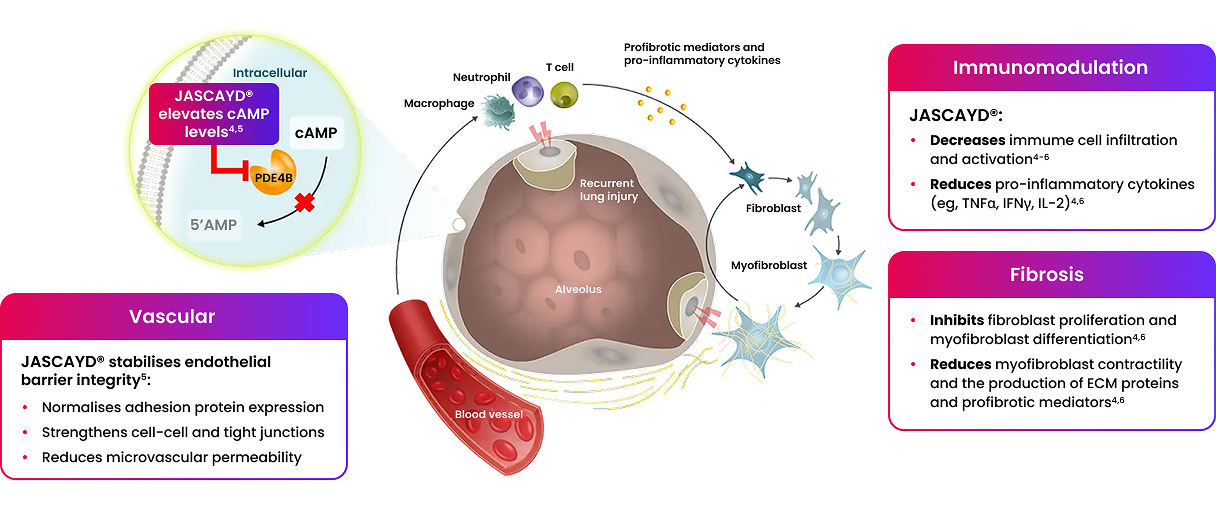
JASCAYD® is a preferential inhibitor of PDE4B with antifibrotic, immunomodulatory and vascular effects.4,5

Results demonstrated in preclinical animal and in vitro human models.4

Introducing JASCAYD®

Clinical evidence

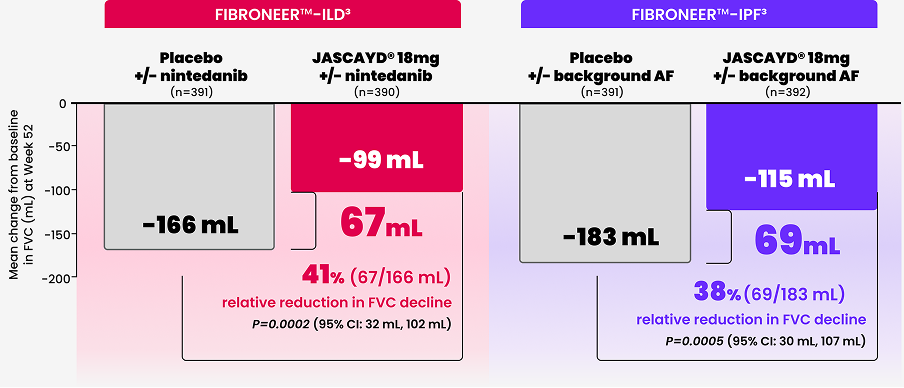
JASCAYD® met the primary endpoint in the FIBRONEERTM-ILD and FIBRONEERTM-IPF trials with a significant reduction in FVC decline vs. placebo at Week 521–3

The primary endpoint was the absolute change from baseline in FVC (mL) assessed at Week 521–3
Clinical evidence

Study design

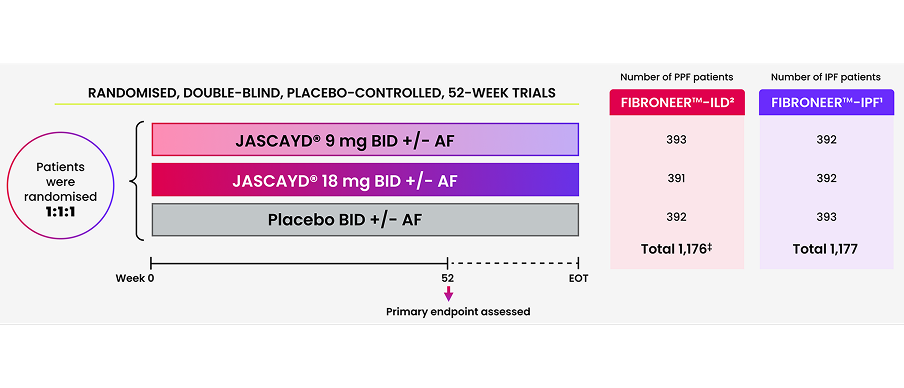
JASCAYD® was evaluated in two of the largest studies conducted in PPF and IPF, involving 2,353 patients in 40+ countries across both trials1,2
Study design
  • +/- AF: Each arm included patients who were on a background AF therapy, or JASCAYD® alone (monotherapy)1,2
  • In FIBRONEERTM-ILD, 44% were on background nintedanib2
  • In FIBRONEERTM-IPF, 45% were on background nintedanib and 32% were on background pirfenidone1

‡ In the FIBRONEERTM-ILD trial, 1178 patients underwent randomisation but 2 patients did not receive trial regimen.2

Safety and tolerability

JASCAYD® demonstrated an acceptable safety and tolerability profile vs. placebo in patients with PPF and IPF3,7,8

When receiving JASCAYD® 18 mg +/- background AF:

Diarrhoea
 
  • For patients with PPF or IPF, diarrhoea was the most common AE. When diarrhoea occurred, it was of mild to moderate severity in most cases and experienced within the first 3 months of treatment3,§

Discontinuation
 

Discontinuations due to diarrhoea:3

Patients with PPF

  • JASCAYD® + background nintedanib:
    4% (7/170)
  • JASCAYD® monotherapy:
    1% (2/220)

Patients with IPF

  • JASCAYD® + background nintedanib:
    13% (23/178)
  • JASCAYD® + background pirfenidone:
    0% (0/127)
  • JASCAYD® monotherapy:
    1% (1/87)
liver monitoring
 
  • No routine liver monitoring required3,*

§ Most cases of diarrhoea were grade 1 or 2 in Common Terminology Criteria for Adverse Events. Grade 1: increase of <4 stools per day; Grade 2: increase of 4–6 stools per day.6,7

* JASCAYD® is not recommended in patients with severe hepatic impairment.3

Adverse reactions associated with JASCAYD® 18 mg3

MedDRA System
Organ Class terminology
MedDRA term
according to MedDRA 27.1
Frequency category
according to EU SPC guideline‖

Gastrointestinal disorders

Diarrhoea

Very common

Nausea

Common

Metabolism and nutrition disorders

Decreased appetite

Common

Investigations

Weight decreased

Very common

Musculoskeletal and connective tissue disorders

Back pain

Common

‖ Frequency categories: very common (≥1/10), common (≥1/100 – <1/10).

Please refer to the JASCAYD® Summary of Product Characteristics for further information.3

For the summary of adverse events and more detailed safety information, please refer to the safety information page.

Safety information page

Dosing & administration

JASCAYD® dosing is one oral tablet, taken twice-daily3

No routine liver monitoring required*
No titration required

Dosing & administration
liver monitoring
Recommended dose

18 mg twice daily

Timing
Timing

Take 1 tablet, ~12 hours apart (morning and evening)

Administration
Administration

Take with or without food, swallowed whole with water. Alternatively, for those with difficulty swallowing, it can be dispersed in approximately 100 mL still, room temperature water

Adjustable
9 mg dosing

Based on individual patient tolerability and eligibility, the dosage may be reduced to 9 mg twice daily​

Missed dose
Missed dose

Resume at the next scheduled time with next dose. The patient should not take an additional dose. 18 mg twice daily should not be exceeded

* JASCAYD® is not recommended in patients with severe hepatic impairment.

▼ This medicine is subject to additional monitoring. This will allow quick identification of new safety information. Healthcare professionals are asked to report any suspected adverse events. Adverse event reporting information can be found at the bottom of this page.

Connect with your local representative

Have questions about JASCAYD® or the clinical data? Your local representative can provide further information and support.

Contact us

Get updated

Stay up to date with our events, products and resources for IPF and PPF

Subscribe

Abbreviations

AE: adverse event; AF: antifibrotic therapy; BID: twice daily; cAMP: cyclic adenosine monophosphate; ECM: extracellular matrix; EOT: end of trial; EU: European Union; FVC: forced vital capacity; IFN: interferon; IL: interleukin; ILD: interstitial lung disease; IPF: idiopathic pulmonary fibrosis; PDE: phosphodiesterase; PPF: progressive pulmonary fibrosis; SPC: Summary of Product Characteristics; TNF: tumour necrosis factor.

  1. Richeldi L, Azuma A, Cottin V, et al. Nerandomilast in patients with idiopathic pulmonary fibrosis. N Engl J Med. 2025;392(22):2193–2202.

  2. Maher TM, Assassi S, Azuma A, et al; FIBRONEER-ILD Trial Investigators. Nerandomilast in patients with progressive pulmonary fibrosis. N Engl J Med. 2025;392(22):2203–2214.

  3. JASCAYD® 18 mg film-coated tablets. Summary of Product Characteristics. Boehringer Ingelheim.

  4. Herrmann FE, Hesslinger C, Wollin L, Nickolaus P. BI 1015550 is a PDE4B inhibitor and a clinical drug candidate for the oral treatment of idiopathic pulmonary fibrosis. Front Pharmacol. 2022;13:838449.

  5. Reininger D, Wolf F, Mayr CH, et al. Insights into the cellular and molecular mechanisms behind the antifibrotic effects of nerandomilast. Am J Respir Cell Mol Biol. 2025;73(5):700–712.

  6. Kolb M, Crestani B, Maher TM. Phosphodiesterase 4B inhibition: a potential novel strategy for treating pulmonary fibrosis. Eur Respir Rev. 2023;32(167):220206.

  7. Wijsenbeek MS, Assassi S, Azuma A, et al. Nerandomilast in progressive pulmonary fibrosis: data from the whole follow-up period of the FIBRONEER-ILD trial. Eur Respir J 2026;2501899.

  8. Oldham JM, Azuma A, Kreuter M, et al. Nerandomilast in idiopathic pulmonary fibrosis: data from the whole follow-up period of the FIBRONEER-IPF trial. Am J Respir Crit Care Med 2026;212(5):972–980.

  9. Wijsenbeek MS, Assassi S, Azuma A, et al. Nerandomilast in progressive pulmonary fibrosis: data from the whole follow-up period of the FIBRONEER-ILD trial. Eur Respir J 2026;2501899 (Supplementary).

  10. Oldham JM, Azuma A, Kreuter M, et al. Nerandomilast in idiopathic pulmonary fibrosis: data from the whole follow-up period of the FIBRONEER-IPF trial. Am J Respir Crit Care Med 2026;212(5):972–980 (Supplementary).

PC-GB-112650 | October 2026

Reporting adverse events

Adverse events should be reported. Reporting forms and information can be found at www.mhra.gov.uk/yellowcard. Adverse events should also be reported to Boehringer Ingelheim Drug Safety on 0800 328 1627 (freephone), or by e-mail: pv_local_uk_ireland@boehringer-ingelheim.com.

Please be aware that this website contains promotional information about Boehringer Ingelheim medicines and services. Some of this may not be directly relevant to your scope of practice and it is your own decision whether you choose to view this information.

  • Contact Us
  • Cookie Policy
  • Privacy Policy
  • Sitemap
  • Terms of Use
  • Accessibility Statement

Boehringer Ingelheim Logo
Boehringer Ingelheim

This information is for UK Healthcare Professionals only. Products discussed herein may have different labelling in different countries. 
Use of this site is subject to the Internet Site Legal Notices and Disclaimers and Privacy Notice.

Copyright © 2021-2026 Boehringer Ingelheim, Inc. All rights reserved. PC-GB-110791 V5 November 2026.